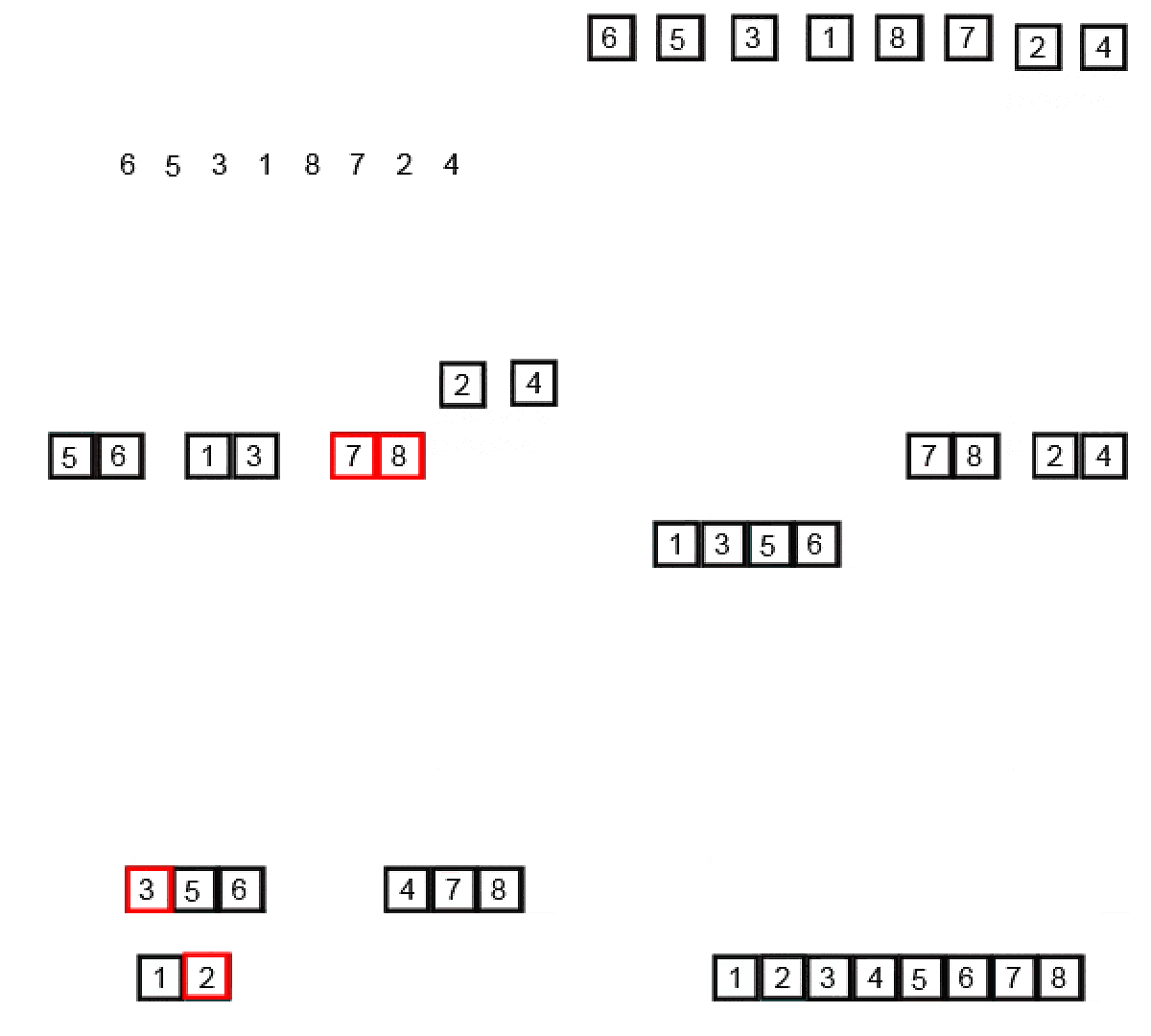
Merge Sort is a popular sorting algorithm that follows the divide and conquer approach. The algorithm works by breaking down the list into smaller sub-lists and sorting them individually.
These sorted sub-lists are then merged back together to obtain the final sorted list.
Time & Space Complexity
Merge sort is a divide and conquer algorithm, it has a logarithmic time complexity of O(n log n)
Merge sort's space complexity is O(n)
What is a merge sort?
Steps of Merge Sort
Divide the unsorted list into smaller sub-lists until each sub-list contains only one element.
Repeatedly merge adjacent sub-lists to produce new sorted sub-lists until there is only one sub-list remaining. This is done by comparing the elements of the sub-lists and merging them in the correct order.
The final sorted list is obtained when all sub-lists are merged.
def merge_sort(arr):iflen(arr)<=1:return arr
mid =len(arr)// 2
left =merge_sort(arr[:mid])
right =merge_sort(arr[mid:])returnmerge(left, right)
def merge(left, right):
result, i, j =[],0,0while i <len(left) and j <len(right):
result.append(left[i]if left[i]< right[j]else right[j])if left[i]< right[j]: i +=1else: j +=1return result + left[i:]+ right[j:]
# Example
print(merge_sort([38,27,43,3,9,82,10]))
Match up the keywords and definitions
Advantages of Merge Sort
Merge Sort guarantees a stable sort, which means that the order of equal elements is preserved.
It performs well on large lists and has a time complexity of O(n log n), where n is the number of elements in the list.
Merge Sort is a stable sorting algorithm. What does it mean?
Disadvantages of Merge Sort:
It is not an in-place sorting algorithm, meaning it needs extra storage proportional to the size of the input list.
Because it is usually implemented using recursion it can be difficult for beginner programmers to implement and understand.
Due to the extra setup it's not efficient for very small lists ( < 40 items)