
Arithmetic Right Shift
In an arithmetic right shift, each bit in a binary number is shifted to the right by a specified number of positions.
- The leftmost bit (the sign bit) is replicated to fill the vacated positions.
- If the number is positive, zeros are shifted in from the left.
- If the number is negative, ones are shifted in from the left.
Arithmetic right shifts are commonly used for division by powers of two in signed integer arithmetic.
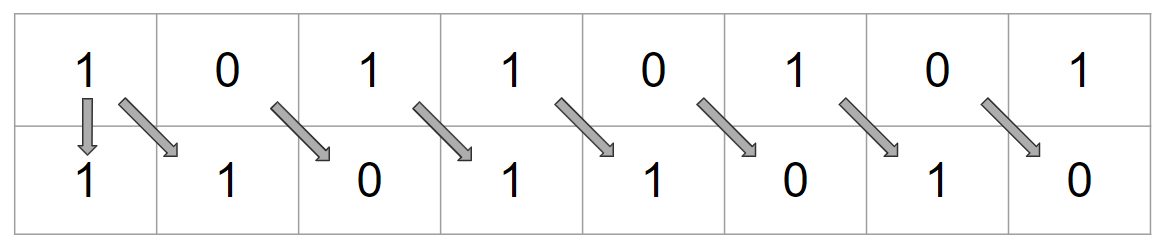
Arithmetic Right Shift - Example
Original number: 1101 (decimal -3)
After arithmetic right shift by 1: 1110 (decimal -2)
Arithmetic Left Shift
In an arithmetic left shift, each bit in a binary number is shifted to the left by a specified number of positions.
- The leftmost bit is lost (shifted out)
- zeros are shifted in from the right.
Arithmetic left shifts are commonly used for multiplication by powers of two in signed integer arithmetic.
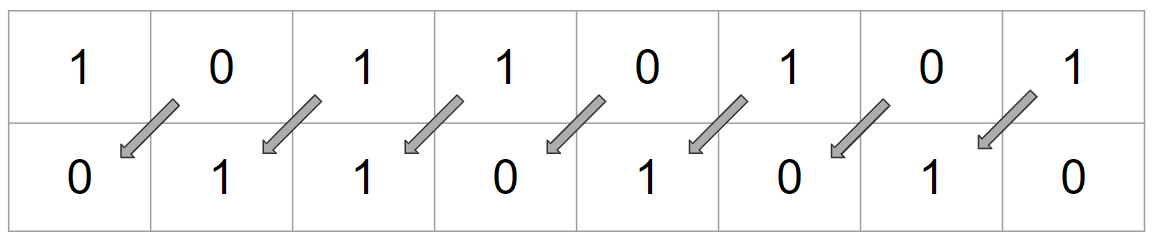
Arithmetic Left Shift - Example
Original number: 1101 (decimal -3)
After arithmetic left shift by 1: 1010 (decimal -6)
Interactive Demonstration
Summary Example - 10001010 (Shift 1)
Left Shift | Right Shift | |
Logical |
00010100 |
01000101 |
Arithmetic |
11000101 |
Review: Fill in the Blanks
In an arithmetic left shift, each bit in a binary number is shifted to the left by a specified number of positions. The leftmost bit is lost (shifted out), and zeros are shifted in from the . Arithmetic left shifts are commonly used for multiplication by powers of two in signed integer .
For example, consider the original number 1101 (decimal -3). After performing an arithmetic right shift by 1, the result is 1110 (decimal -2). In contrast, if we perform an arithmetic left shift by 1 on the same original number, the result changes to 1010 (decimal -6). It is important to understand how the sign bit is treated during these and its effect on the final values.
Complete! Ready to test your knowledge?
Arithmetic Binary Shifts
- Arithmetic Right Shift
- Arithmetic Right Shift - Example
- Arithmetic Left Shift
- Arithmetic Left Shift - Example
- Interactive Demonstration
- Summary Example - 10001010 (Shift 1)