Parity bit checks are a simple form of error-checking used in digital systems to detect errors in binary data. They work by adding an extra bit, called a parity bit, to a group of binary bits.
The purpose of the parity bit is to ensure that the total number of ones (1s) in the binary data, including the parity bit, follows a specific rule, either even or odd parity.
There are two common types of parity checks: even parity and odd parity.
{"keyword": "parity bits", "definition": "Bits added to binary data to ensure an even or odd count of 1s."}
Even Parity
In even parity, the rule is that the total number of ones in the binary data, including the parity bit, must be an even number.
To implement even parity, if the data already has an even number of ones, the parity bit is set to 0 (zero).
If the data contains an odd number of ones, the parity bit is set to 1 (one) to make the total number of ones even.
Example
If we have a group of 7 bits 1011011, the total number of 1 is 5. This is an odd number and therefore we need to add a one to the end in order to achieve even parity.
Result - 10110111
When the data is received, if the number of 1s in the byte is an odd number we know that a transmission error has occurred.
Parity Bit Demonstration
Block Parity Demonstration
Click on cells to change their values. The parity bit will be calculated dynamically.
Data 1
Data 2
Data 3
Parity Bit
0
0
0
0
What is the correct even parity bit for the binary number 1011?
{"answers": {"A": "1", "B": "Parity bit cannot be determined", "C": "0", "D": "2"}, "question_text": "What is the correct even parity bit for the binary number 1011?", "correct_answer": "A"}
Odd Parity
In odd parity, the rule is that the total number of ones in the binary data, including the parity bit, must be an odd number.
To implement odd parity, if the data already has an odd number of ones, the parity bit is set to 0 (zero).
If the data contains an even number of ones, the parity bit is set to 1 (one) to make the total number of ones odd.
Example
If we have the group of bits 1011011, the total number of 1s is 5. This is an odd number and so it is already in odd parity. Therefore we simply add a 0
Result - 10110110
If a transmitted code has an even number of 1s but the receiver expects an odd number, it means there is a [[error]].
{"cloze_text": "If a transmitted code has an even number of 1s but the receiver expects an odd number, it means there is a [[error]]."}
Use cases for parity bits
Data Transmission and Communication
Parity bits are used to detect errors in data sent from one device to another in communication protocols.
Storage Systems (RAID)
Parity bits are employed in RAID systems to provide fault tolerance and data recovery in case of drive failure.
Memory Systems (RAM)
Parity bits are used in computer memory to identify and, in some cases, correct single-bit errors in data stored in memory.
Parity bits are used to [[detect]] single bit errors in data transmission.
{"cloze_text": "Parity bits are used to [[detect]] single bit errors in data transmission."}
Advantages of Parity Bits
Simplicity
Parity bits are straightforward to implement and require minimal hardware or software resources. They add a basic layer of error detection without significant overhead.
Low Overhead
Parity bits add only one extra bit to the data, making them a cost-effective method for basic error checking.
Real-Time Detection
Errors can be detected in real-time, which is important for applications like data communication.
What is an advantage of using parity bits in error detection?
{"answers": {"A": "They provide strong protection against multiple-bit errors", "B": "They can detect single-bit errors efficiently", "C": "They can correct single-bit errors automatically", "D": "They are simple and easy to implement"}, "question_text": "What is an advantage of using parity bits in error detection?", "correct_answer": "D"}
Limitations of Parity Bits
Cannot Correct Errors
Parity bits can only detect errors; they cannot correct them. More advanced error-correction methods are needed for error correction.
Limited Error Detection
Parity bits are limited to detecting single-bit errors. They may not detect multiple errors occurring in the same data word.
No Error Location Information
Parity bits cannot pinpoint the exact location of an error within the data. They only indicate that an error has occurred.
The use of parity bits adds [[overhead]] to the transmitted data.
{"cloze_text": "The use of parity bits adds [[overhead]] to the transmitted data."}
Checksums
A checksum is a value derived from a set of data, typically in digital form, that is used to verify the data's integrity and detect errors that may have occurred during data transmission or storage. Checksums are widely used in computing and data communication to ensure data reliability.
In Python programming, what is the purpose of a checksum?
{"answers": {"A": "A technique for compressing data", "B": "A method for encrypting data", "C": "A function to generate unique file identifiers", "D": "An algorithm used to detect errors in data transmission or storage"}, "question_text": "In Python programming, what is the purpose of a checksum?", "correct_answer": "D"}
Checksum Calculation Process
1. Split the data into a number of blocks(k) with a fixed number of bits (n) in each block.
2. Sum up all of the k blocks data using binary addition.
3. If there is a carry in the sum, add this to the sum.
4. Perform 1's Complement on the sum
This will provide us with the checksum value.
A checksum is a small piece of [[data]] derived from another piece of data.
{"cloze_text": "A checksum is a small piece of [[data]] derived from another piece of data."}
Checksum Calculation Demonstration
Checksum Use cases
Data Transmission Integrity
Used to verify data integrity during transmission, such as in network protocols like TCP.
File Integrity Verification
Ensures files remain unaltered during transfer or storage, often used in downloads and backups.
Password Storage Security
Enhances security by storing password hashes instead of plaintext passwords, protecting user credentials.
Checksums are used to verify the [[integrity]] of data.
{"cloze_text": "Checksums are used to verify the [[integrity]] of data."}
Advantages of Checksums
Effective Error Detection
Checksums effectively detect errors and corruption in data during transmission or storage, providing data integrity.
Efficiency
They are computationally efficient and can quickly verify data integrity without requiring significant resources.
Ease of Implementation
Checksums are relatively easy to implement in software and hardware systems.
Wide Applicability
Checksums can be used in various applications, from network communication to file transfers.
What is an advantage of using checksums in data transmission?
{"answers": {"A": "They improve data transmission speed", "B": "They provide data encryption", "C": "They reduce the amount of data sent", "D": "They help detect errors in transmitted data"}, "question_text": "What is an advantage of using checksums in data transmission?", "correct_answer": "D"}
Limitations of Checksums
No Error Correction
Checksums detect errors but do not correct them, limiting their utility in applications where error correction is critical.
Limited Error Detection
The effectiveness of checksums depends on the chosen algorithm and may not catch all types of errors.
Cryptographic Weakness
Some simple checksum algorithms are vulnerable to deliberate tampering and may not be suitable for security-critical applications.
False Positives/Negatives
Checksums can generate false positives or false negatives, indicating errors when data is actually intact or missing errors when they are present.
Are checksums completely reliable in detecting errors during data transmission?
{"answers": {"A": "Only when used with specific error-correcting codes", "B": "Only for small data packets", "C": "No, checksums can fail to detect some errors", "D": "Yes, checksums always detect all errors"}, "question_text": "Are checksums completely reliable in detecting errors during data transmission?", "correct_answer": "C"}
Echo Check
An echo check is a simple form of error checking in Computer Science and networking where the received data is immediately retransmitted back to the sender. If the sender receives the same data back they sent then they know it is highly likely that the receiver has received the data correctly.
In network troubleshooting, an administrator might use an echo check to verify the connectivity and integrity of a network connection. They send a test signal, and if they receive the same signal back, it indicates that the network link is operational. If they don't receive the expected echo, it suggests a problem with the connection or data transmission.
{"keyword": "echo check", "definition": "The process of verifying the integrity of network data by sending a request packet and comparing the echoed response packet."}
What is the primary purpose of a network data echo check?
{"answers": {"A": "To encrypt data for secure transmission", "B": "To route network traffic to its destination", "C": "To prevent unauthorized access to a network", "D": "To verify that data sent across the network is received correctly by sending it back"}, "question_text": "What is the primary purpose of a network data echo check?", "correct_answer": "D"}
Automatic Repeat Query (ARQ)
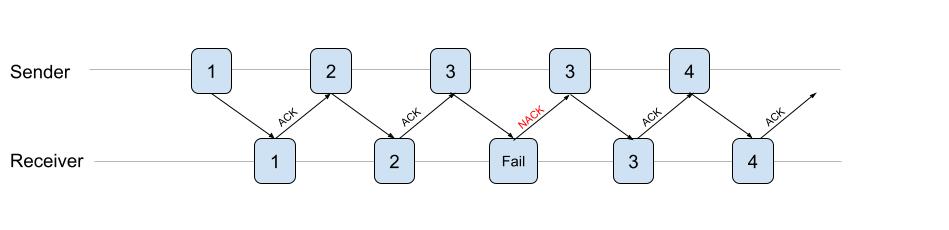
This is a protocol for error control over unreliable or noisy network connections. For each frame sent an acknowledgement is sent from the receiver to indicate that the frame has been successfully used. Checksums / check-digits are used to check the data integrity and timeouts are used if not reply is received.
There are 3 versions of ARQ:
Stop & Wait
Stop n go back
Selective repeat
The main purpose of Automatic Repeat Query is to detect and correct [[errors]] in data transmission.
{"cloze_text": "The main purpose of Automatic Repeat Query is to detect and correct [[errors]] in data transmission."}
The Stop and Wait ARQ
Data is sent from the sender to the receiver. Once sent the sender waits a certain amount of time for a response from the receiver.
The receiver uses the checksum/check digit from the frame to check the frame and ensure that data has been received correctly.
The user sends a positive acknowledgement(ACK) to the sender to indicate the data been received correctly or a negative acknowledgement to indicate that the data has been corrupted.
If the data has been incorrectly received or a time-out occurs(the time wait limit is exceeded) the sender resends the data.
This process is repeated until all data has been received.
ARQ relies on the use of [[acknowledgement]] packets to confirm that data has been successfully received.
{"cloze_text": "ARQ relies on the use of [[acknowledgement]] packets to confirm that data has been successfully received."}
Go back & ARQ
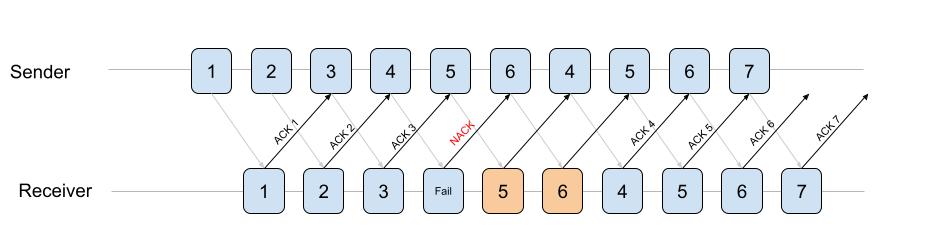
In stop and go back ARQ the sender keeps sending data through in a constant stream, without waiting for an acknowledgment from the receiver – it just assumes that the data has been received successfully. If a negative acknowledgement is received or a timeout occurs the sender goes back to the last known good acknowledgement and starts again from there.
This is an improvement over stop and wait because the senders full bandwidth can be used.
Which transport layer protocol commonly uses Automatic Repeat reQuest (ARQ) for error control?
Selective Repeat is an improvement over Go Back & ARQ because only the frames that have been unsuccessfully received are retransmitted, rather than having to start all over again.
ARQ protocols typically use [[feedback]] mechanisms to adjust the transmission rate based on network conditions.
{"cloze_text": "ARQ protocols typically use [[feedback]] mechanisms to adjust the transmission rate based on network conditions."}
Check Digits
Data entry check digits, also known as verification digits or data entry verification codes, are special digits included in data to help prevent and detect errors during manual data entry. They are commonly used in applications where accurate data input is essential to avoid mistakes and maintain data integrity. Data entry check digits are calculated based on the other data digits and serve as a safeguard against input errors.
Why is a check digit used in data entry or transmission?
{"answers": {"A": "It reduces the likelihood of identity theft", "B": "It adds an extra layer of security to computer systems", "C": "It improves the efficiency of the production process", "D": "It helps detect errors in data entry or transmission"}, "question_text": "Why is a check digit used in data entry or transmission?", "correct_answer": "D"}
Luhn’s Algorithm
Luhn’s algorithm is a credit digit algorithm that uses modulo to detect simple errors. It is commonly used on 15 digit credit card numbers to automatically calculate the 16th digit.
Algorithm Steps
Write all the digits down in order.
For each number in the sequence that is in an odd position (first, third, fifth,etc) multiply that number by two and add each of the digits of the result together.
For each number in the sequence that is in even position, leave it as is.
Now add up all the resultant numbers together (including the ones you left as is)
Work out 10 minus modulo 10 of the total ( = 10 – Total MOD 10 )
The answer becomes the16th digit.
{"keyword": "Luhn algorithm", "definition": "A mathematical method that verifies the validity of identification numbers using a checksum calculation."}
Luhns Algorithm Presentation
The calculation of a [[check digit]] involves performing mathematical operations on the other digits in the number.
{"cloze_text": "The calculation of a [[check digit]] involves performing mathematical operations on the other digits in the number."}
Check Digit Use Cases
Credit Card Validation
Data entry check digits are commonly used in credit card numbers to ensure the validity and accuracy of the card data during transactions. The Luhn algorithm, for example, verifies that credit card numbers are correctly entered, reducing the risk of payment errors.
ISBN Validation
The International Standard Book Number (ISBN) includes a check digit to verify the accuracy of book identification numbers. This helps ensure that books are correctly identified in libraries and databases.
Barcodes and UPCs
Product barcodes, particularly the Universal Product Code (UPC), often include check digits to prevent errors during product scanning and inventory management. The check digit ensures that the barcode data is correctly entered or scanned, reducing errors in retail and logistics.
(ISBN & Barcodes use a x3 multiplier instead of x2)
What is the purpose of a check digit in a barcode?
{"answers": {"A": "To encode additional information about the product", "B": "To track the product's location in inventory", "C": "To ensure the barcode can be scanned accurately", "D": "To prevent errors during data entry or scanning"}, "question_text": "What is the purpose of a check digit in a barcode?", "correct_answer": "C"}
Parity Block Checks
Parity block checks are used in data storage and data transmission systems to add an additional layer of error detection to a group of bytes (usually a larger chunk of data). They are similar in concept to parity bits, but instead of applying parity to individual bits within a byte, they apply it to a group of parity bytes.
The purpose of parity bytes is to detect errors in a larger data unit, such as a block of data, rather than just individual bits or bytes. By using parity bytes, you can detect errors in the entire data block more effectively.
How is parity typically calculated in a parity block in Python?
{"answers": {"A": "By counting the number of 1s in the data block", "B": "By generating a random parity bit", "C": "By summing all bits and dividing by the block size", "D": "By performing an XOR operation on all bits in the data block"}, "question_text": "How is parity typically calculated in a parity block in Python?", "correct_answer": "D"}
Interactive Demonstration
With block parity the bits are treated as a 2 dimensional matrix, and parity bits are calculated for each row and column.
Click on cells to change their values. Row and column parity will be calculated dynamically.
Data 0
Data 1
Data 2
Data 3
Row Parity
0
0
0
0
0
0
0
0
0
0
0
0
0
0
0
0
0
0
0
0
Column Parity
0
0
0
0
0
In a parity-based error detection system, what typically happens when an error is detected in a parity block?
{"answers": {"A": "The data block containing the error is marked as corrupted", "B": "The error is ignored and data is processed as usual", "C": "The error is automatically corrected using parity information", "D": "An error is reported for further handling"}, "question_text": "In a parity-based error detection system, what typically happens when an error is detected in a parity block?", "correct_answer": "D"}
Block Parity Use Cases
RAID Systems
Block parity is a fundamental component of RAID configurations, ensuring data redundancy and fault tolerance. If one drive fails, block parity information is used to rebuild the missing data, ensuring data integrity and availability.
ECC Memory
Block parity is essential in ECC memory, which detects and corrects errors in RAM, especially in server environments.
Data Storage and Archiving
It is widely used to protect data integrity in storage, backup, and archival systems.
Data Transmission and Communication
In certain data communication protocols, especially those used in satellite communication or deep-space missions, block parity may be employed to guarantee data integrity in the presence of signal noise or interference
Parity blocks are commonly used in [[RAID]] systems.
{"cloze_text": "Parity blocks are commonly used in [[RAID]] systems."}
Advantages of Parity Blocks
Error Detection
Block parity checks can effectively detect errors in data, including single-bit and some multi-bit errors. This is the main advantage over parity bits.
Data Redundancy
In RAID systems, block parity provides data redundancy, allowing for data recovery in the event of drive failures.
Simple Implementation
Block parity checks are relatively easy to implement and add a basic level of error detection without significant computational overhead.
The use of parity blocks improves the [[reliability]] of data storage.
{"cloze_text": "The use of parity blocks improves the [[reliability]] of data storage."}
Limitations of Parity Blocks
No Error Correction
Block parity checks can detect errors but cannot correct them. They are limited to identifying errors but not fixing them.
Limited Error Detection
While they can detect single-bit errors and some multi-bit errors, they may not be effective against more complex errors, such as certain types of multi-bit errors or burst errors.
Overhead
In storage systems, the use of block parity introduces overhead in terms of the storage capacity required for parity information. This can reduce the overall usable storage capacity.
Performance Impact
Calculating and updating block parity information can have a performance impact, especially in real-time data storage and retrieval scenarios.
{"keyword": "Capacity Overhead", "definition": "The additional storage space required to store parity blocks, reducing the overall usable capacity of a RAID system."}
CheckSum Video Tutorial
Error Checking Video
Review: Fill in the Blanks
and correction plays a crucial role in maintaining in various systems. One common technique for error detection is the use of . Parity bits are additional bits added to a set of data to enable error detection. There are two types of parity: and .
Odd parity ensures that the total sum of bits (including the parity bit) is an odd number, while even parity ensures an even total sum. These parity bits introduce , enabling the system to identify and correct errors, thus enhancing .
In certain storage systems like (Redundant Array of Independent Disks), are used to detect and correct errors. determines the parity block by performing logical operations on the data blocks, allowing for high fault tolerance. However, this method incurs a because of the need to store additional parity information.
Other techniques, such as s, (Message Digest 5), and (Cyclic Redundancy Check), are used for error detection. Checksums provide a simple and efficient mechanism to verify data integrity by summing all the data values and storing the total. Any changes in the data will result in a different checksum value.
CRC, on the other hand, employs polynomial division to generate a unique remainder that serves as the checksum. This remainder is appended to the data, enabling the receiver to validate the data's integrity. Similarly, and (ARQ) methods involve and to overcome and ensure error-free data transmission. They rely on messages and s to manage retransmission and maintain the of transmitted packets.
Another technique, the , uses a to detect errors in numbers, commonly used in credit card numbers and identification numbers. The Luhn algorithm calculates the check digit based on the sum of the digits, allowing for quick error detection.
Click the keywords below to fill in the blanks:
MD5
Parity Blocks
Acknowledgment
Luhn Algorithm
Automatic Repeat Query
Packet Loss
Retransmission
Parity Bits
Fault Tolerance
Error Detection
RAID
Checksum
Feedback
Data Integrity
Capacity Overhead
Echo Check
Timeout
Parity Calculation
Sequence Number
Odd Parity
Even Parity
CRC
Redundancy
Check Digit