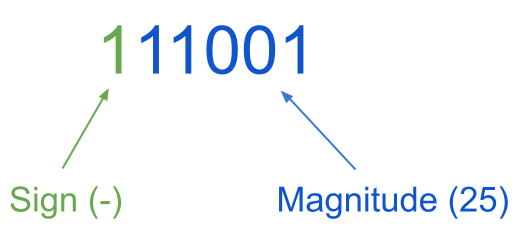
With binary we need a method of representing negative numbers. The simplest way to do this (though not the best) is to use the sign and magnitude method.
In sign and magnitude binary, a number is expressed using a combination of a sign bit and a magnitude (the absolute value of the number). They combine together to make the full signed number.
The sign bit indicates positive (0) or negative (1) and the rest of the number is just a normal binary number.
In the example above the number -25 is represented by the sign bit (1) and the absolute value (11001)
What is an advantage of using sign and magnitude representation for binary numbers?
{"answers": {"A": "It is simple to understand and implement", "B": "It supports a larger range of values than two's complement", "C": "It provides a unique representation for zero", "D": "It allows for easy arithmetic operations"}, "question_text": "What is an advantage of using sign and magnitude representation for binary numbers?", "correct_answer": "A"}
In sign and magnitude representation, the binary number 10011011 represents the decimal number [[-27]].
{"cloze_text": "In sign and magnitude representation, the binary number 10011011 represents the decimal number [[-27]]."}
In sign and magnitude binary representation, what does it mean if the leftmost bit (sign bit) and all other bits are zero?
{"answers": {"A": "It represents negative zero", "B": "It represents the smallest positive number", "C": "It represents zero", "D": "It is an invalid representation"}, "question_text": "In sign and magnitude binary representation, what does it mean if the leftmost bit (sign bit) and all other bits are zero?", "correct_answer": "C"}
Issue 1: Two Representations of Zero
In sign and magnitude representation, there are two representations of zero - one positive (all bits set to 0) and one negative (sign bit set to 1, all other bits set to 0). This can cause confusion and lead to errors in calculations and comparisons.
For example 0000 = 0 ; 1000 = 0
Using sign and binary the number 20 is represented as [[010100]].
{"cloze_text": "Using sign and binary the number 20 is represented as [[010100]]."}
What is a primary disadvantage of sign and magnitude representation in binary numbers?
{"answers": {"A": "It has two representations for zero, complicating arithmetic operations", "B": "It cannot represent negative numbers", "C": "It is incompatible with binary addition", "D": "It requires more bits than two's complement for the same range"}, "question_text": "What is a primary disadvantage of sign and magnitude representation in binary numbers?", "correct_answer": "A"}
In sign and magnitude binary, there are [[two]] representations for zero.
{"cloze_text": "In sign and magnitude binary, there are [[two]] representations for zero."}
Issue 2: Difficulty in Performing Arithmetic Operations
Performing arithmetic operations, such as addition and subtraction, on sign and magnitude numbers can be complex.
Additional logic is required to handle the signs, which makes the operations more difficult and processor intensive to implement using digital circuitry.
Review: Fill in the Blanks
With binary we need a method of representing numbers. The simplest way to do this (though not the best) is to use the and magnitude method. In sign and magnitude binary, a number is expressed using a combination of a and a magnitude (the absolute value of the number). They combine together to make the full signed number. The sign bit indicates (0) or (1) and the rest of the number is just a normal binary number. In the example above the number -25 is represented by the sign bit (1) and the absolute value (11001).
Sign and Magnitude has two key issues: the first is that there are two representations of - one positive (all bits set to 0) and one negative (sign bit set to 1, all other bits set to 0). This can cause and lead to errors in calculations and comparisons. For example 0000 = 0 ; 1000 = 0. The second issue is the difficulty in performing operations, such as addition and subtraction, on sign and magnitude numbers. Additional logic is required to handle the , which makes the operations more difficult and processor intensive to implement using digital circuitry.
Click the keywords below to fill in the blanks:
Positive
Arithmetic
Sign Bit
Confusion
Sign
Negative
Signs
Negative
Zero