
Introduction to Two’s Complement
Early computers used sign-and-magnitude to represent signed numbers:
- Leftmost bit = sign (0 = +, 1 = –)
- Remaining bits = magnitude
+5 = 0000 0101 -5 = 1000 0101
But this system had major problems:
- Two zeros → 0000 0000 (+0) and 1000 0000 (–0)
- Addition doesn’t work naturally – you need special rules depending on the signs
- Comparison is messy – negative zero creates confusion
To fix this, computers use two’s complement, which:
- Has only one representation of zero
- Makes addition and subtraction work with ordinary binary circuits
- Represents negative numbers by inverting the bits and adding 1
Why is two's complement representation preferred over sign-magnitude representation in binary arithmetic?
Calculating the Two's Complement of a number
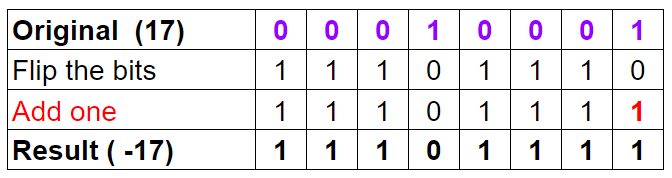
To calculate the negative value of a number:
- invert (flip) all the bits
- and add 1 to the resulting number.
This process converts the positive number into its negative counterpart.
Notes
- when you add one to the number you perform a carry just like in normal binary addition.
- Ignore any binary overflow from beyond the digits you use
- A positive number needs to begin with a zero before conversion, so if it doesn't start with zero you will need to add a zero to the left.
What is the first step in finding the two's complement of a binary number?
Advantages of Two's Complement
1. Simplicity
Two's complement is a simple method of representing both positive and negative numbers using binary digits. It allows for easy arithmetic operations and logical manipulations.
2. Range of Representation
With two's complement, a wider range of values can be represented using a fixed number of bits compared to other number systems. This allows for efficient storage and manipulation of data.
3. Efficiency in Circuit Design
Two's complement is widely used in digital circuit design for arithmetic operations in processors, microcontrollers, and other electronic devices. Its efficient representation of negative numbers simplifies circuit design and reduces the complexity of hardware implementation.
4. Compatibility
Two's complement is compatible with various arithmetic algorithms and logic circuits, making it suitable for use in both hardware and software implementations. It is widely supported in computers, calculators, and digital systems.
Review: Fill in the Blanks
Two's complement is a simple method of representing both positive and negative numbers using binary digits. It allows for easy operations and logical manipulations. With Two's complement, a wider range of values can be represented using a fixed number of bits compared to other number systems. This allows for efficient storage and of data. Two's complement is widely used in digital circuit design for arithmetic operations in processors, microcontrollers, and other electronic devices. Its efficient representation of negative numbers simplifies circuit design and reduces the of hardware implementation.
Additionally, Two's complement is compatible with various arithmetic algorithms and logic circuits, making it suitable for use in both and software implementations. It is widely supported in computers, , and digital systems.
Complete! Ready to test your knowledge?
Two's Complement
- Introduction to Two’s Complement
- Calculating the Two's Complement of a number
- Advantages of Two's Complement