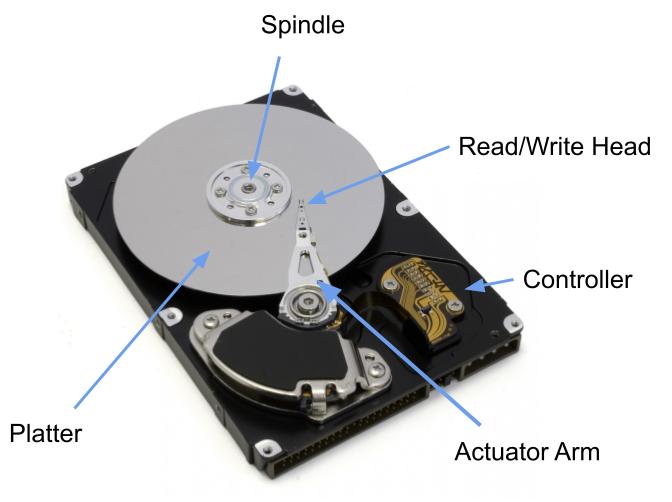
A hard disk drive (HDD) is a magnetic storage device used for storing and retrieving digital information. It consists of one or more rotating disks coated with a magnetic coating and a magnetic head that reads and writes data.
The magnetic coating on the disks contains billions of tiny areas that can be magnetized in two directions, representing binary digits (0 and 1). The magnetic head, mounted on an actuator, hovers above the spinning disks and magnetizes or detects changes in magnetism on the surface.
HDDs are commonly used in computers, laptops, and servers to store operating systems, software, and user files.
Which of the following is not a type of magnetic disk?
Components of a HDD
Platters
The disks coated with a magnetic layer where data is stored.
Spindle
The motor that rotates the platters at a high speed.
Read/Write Head
The component that reads and writes data on the platters.
Actuator Arm
The arm that holds the magnetic head and moves it across the platters.
Controller
The circuit that coordinates all the other components and sends the data to the CPU along the data bus.
Which of the following is responsible for reading and writing data on a hard disk?
Advantages of HDD Drives
Large storage capacity compared to other storage devices.
Relatively low cost per unit of storage.
Faster data access times compared to other traditional storage options.
Can be easily replaced or upgraded.
Can retain data even when powered off.
What is the storage capacity of a typical hard disk drive?
Disadvantages of HDD Drives
Not as durable as solid-state drives (SSDs) due to mechanical moving parts.
Slower data transfer rates compared to SSDs.
Data can become fragmented, slowing read speeds.
Consumes more power and generates more heat compared to SSDs.
Not suitable for extreme environmental conditions.
Which type of drive is more susceptible to shocks and drops?
Magnetic Tape Drives
Magnetic tape is a type of magnetic storage device used for storing digital data. It consists of a thin plastic strip coated with a magnetic material. Information is stored on magnetic tape by magnetizing particles on the tape's surface. Data can be read by passing the tape over a magnetic reading head.
Magnetic tape is commonly used for archival storage of large amounts of data, such as backups and historical records. It is also used for audio and video recording.
Magnetic tape
Advantages of magnetic tape drives
High storage capacity
Low cost compared to other storage devices
Long durability
Portability of the tapes allowing for easy offsite storage
Sequential access allows for efficient data retrieval
What is magnetic tape mainly used for?
Disadvantages of magnetic tape drives
Slow data access compared to other storage devices
Not suitable for random access of data
Susceptible to magnetic fields, which can lead to data loss
Which of the following is a disadvantage of magnetic tape?
is the amount of time it takes for a storage device to locate and retrieve data.